Edging is an advanced arousal control technique that takes your stamina training to the next level. While the Stop-Start method teaches you to stop and reset, edging teaches you to stay in control at the edge — riding high arousal without going over.
If Stop-Start is learning to brake, edging is learning to cruise at high speed with precision control.
What Is Edging?
Edging (also called "surfing" or "peaking") is the practice of bringing yourself to the brink of orgasm and then reducing (but not stopping) stimulation to maintain that high arousal level without ejaculating.
The goal isn't to avoid pleasure — it's to expand your pleasure window. Men who practice edging report longer sessions, more intense sensations, and dramatically more control during partnered sex.
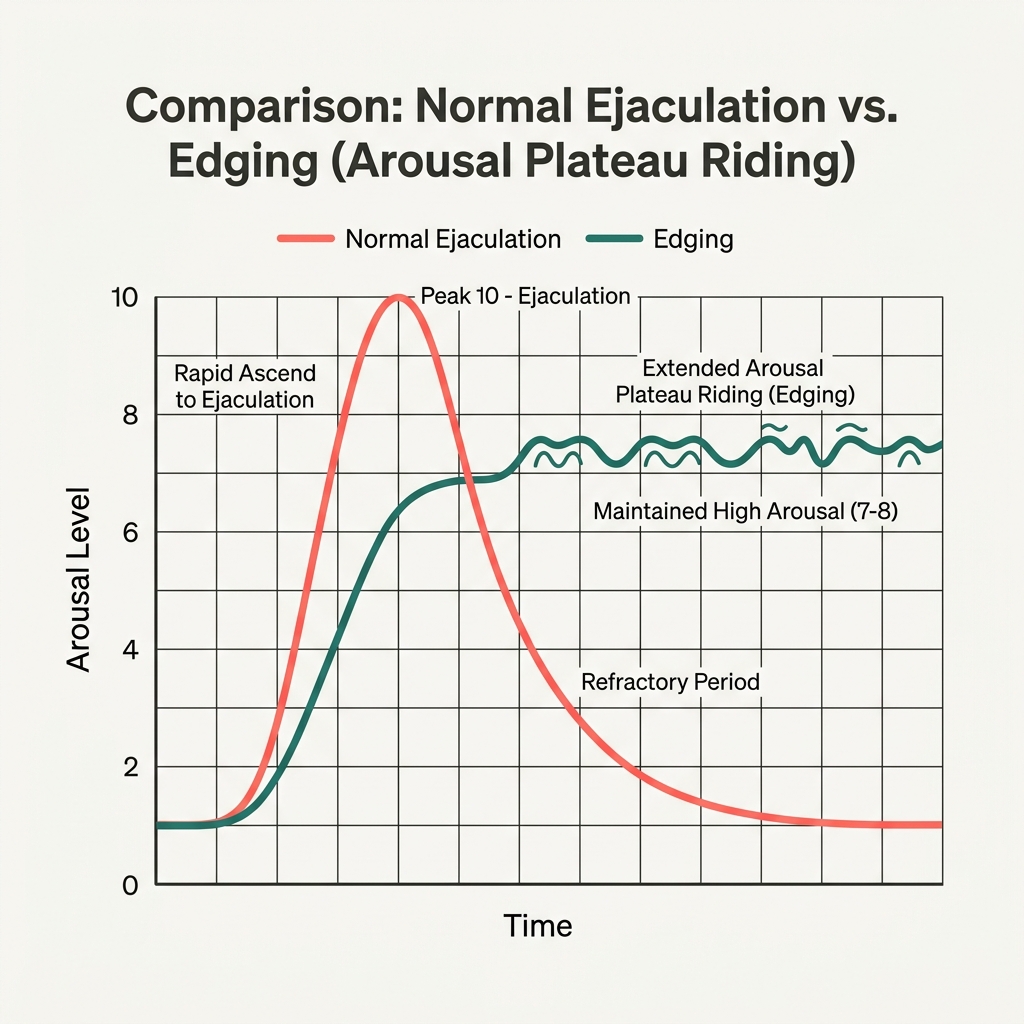
Edging builds on Stop-Start. If you haven't practiced the Stop-and-Start method for at least 2 weeks, start there first. Jumping to edging without foundational arousal awareness often leads to frustration.
Prerequisites: Master Stop-Start First
Before attempting edging, you should be able to:
- ✅ Accurately rate your arousal on a 1-10 scale
- ✅ Consistently stop at 7-8 without accidentally going past the PONR
- ✅ Complete 3-5 stop-start cycles in a single session
- ✅ Use breathing techniques during rest phases
- ✅ Maintain sessions of at least 8-10 minutes
If you can do all of the above, you're ready for edging.
3 Core Edging Techniques
1. Surfing (The Foundation)
Surfing is the most basic edging technique. You bring your arousal to 7-8, then reduce stimulation speed/pressure just enough to stay at that level without dropping or climbing.
Build to the edge
Stimulate until you reach 7-8 on the arousal scale.
Slow down dramatically
Reduce speed by 70-80%. Don't stop — maintain light, slow contact.
Hold the edge
Try to maintain 7-8 arousal for 30-60 seconds. Use breathing to regulate. This is "surfing the wave."
Drop and rebuild
Let arousal drop to 5-6, then build back up. Each cycle strengthens control.
2. Plateau Riding (Intermediate)
Plateau riding extends the surfing concept. Instead of hovering at 7-8 for short bursts, you aim to maintain a stable plateau at 6-7 for several minutes at a time.
The key is finding the exact stimulation intensity that keeps you aroused but not climbing. Think of it like cruise control — you're maintaining a steady speed rather than accelerating and braking.
- Find a moderate pace that feels pleasurable but doesn't escalate arousal
- Maintain this pace for 2-3 minutes at a time
- Use micro-adjustments in speed/pressure rather than full stops
- Breathe rhythmically to maintain the parasympathetic response
3. Tempo Variation (Advanced)
The most advanced edging technique combines surfing with deliberate changes in stimulation intensity. This trains your nervous system to handle unexpected arousal spikes — exactly what happens during partnered sex.
- Slow → Fast → Slow: Build arousal quickly, then immediately slow down to maintain the edge
- Light → Firm → Light: Vary pressure intensity within a single cycle
- Start-Stop Micro-Bursts: Very brief (2-3 second) stops interspersed with continuous stimulation
This variation is the closest to real-world sexual situations where arousal levels change dynamically.

Step-by-Step Practice Guide
Here's a complete edging practice session:
Warm Up (2-3 minutes)
Start with slow stimulation. Do 1-2 basic stop-start cycles to get your body into "training mode" and calibrate your arousal awareness.
First Edge — Surfing (2-3 minutes)
Build to 7-8, then reduce speed and try to surf at that level for 30 seconds. If you start to go higher, slow down more or stop briefly. Let arousal drop to 5-6.
Second Edge — Extended Surf (3-4 minutes)
Build up again. This time, try to surf at 7-8 for 60 seconds or more. You'll notice it gets easier each cycle as your body adapts.
Third Edge — Intensity Variation (3-5 minutes)
Build to the edge, then try varying your stimulation while maintaining high arousal. Speed up briefly, then slow back down. This builds real-world adaptability.
Cool Down
End the session however you choose. Take note of your total session time and how many edges you achieved.
Safety & Tips
Is edging safe?
Yes, completely. There are no known medical risks to edging. Some men may experience temporary pelvic discomfort (colloquially called "blue balls") if arousal is maintained for very long periods, but this is harmless and resolves naturally.
Tips for Success:
- Use a timer — It's hard to judge time during practice. A timer keeps you honest and provides data to track improvement.
- Breathe intentionally — Box breathing (4-4-4-4) is your primary tool for controlling arousal. Use it during every edge.
- Don't chase perfection — Going over the edge occasionally is normal and expected. Treat it as data (you now know where your limit was) rather than failure.
- Start shorter — A 10-minute edging session is plenty. You can extend as your control improves.
- Track every session — Number of edges, total time, subjective difficulty. Patterns emerge that show real progress.
From Stop-Start to Edging: Progression Path
Here's the recommended timeline for progression:
- Weeks 1-2: Basic Stop-Start (complete stops, 3-5 cycles per session)
- Week 3: Transition (mix of complete stops and slow-downs)
- Week 4+: Full edging (surfing, plateau riding, tempo variation)
This progressive approach is based on clinical training protocols and maximizes long-term results.
Train Smarter with TimingCoach
TimingCoach guides you through this exact progression — from basic Stop-Start to advanced edging — with a structured 4-week program, adaptive timers, and real-time haptic coaching. Build lasting control without guesswork.


Frequently Asked Questions
What is edging?
Edging is a technique where you bring yourself to the brink of climax and then reduce (but don't stop) stimulation to stay at high arousal without ejaculating. It builds fine-grained control of your arousal levels.
Is edging safe?
Yes, completely safe. There are no medical risks. Temporary pelvic discomfort may occur with very prolonged sessions, but it's harmless and resolves on its own.
How is edging different from Stop-Start?
With Stop-Start, you completely stop stimulation when approaching climax. With edging, you reduce but don't stop, learning to hover at high arousal. Edging is more advanced and should be attempted only after mastering Stop-Start.
Can edging help with premature ejaculation?
Yes. Edging builds on the same principles as the clinically validated Stop-Start technique (82.5% effectiveness rate, PMC10414676) and takes arousal control further. Most men who combine Stop-Start with edging report the best long-term results.