The Stop-and-Start method is the most clinically validated technique for overcoming premature ejaculation — and it doesn't require any medication, devices, or supplements. In this guide, you'll learn exactly how to practice it, what to expect each week, and how to avoid the most common mistakes.
What Is the Stop-and-Start Method?
The Stop-and-Start method (also known as the Semans technique, after urologist Dr. James Semans who developed it in 1956) is a behavioral training approach that teaches you to tolerate higher levels of sexual arousal without ejaculating.
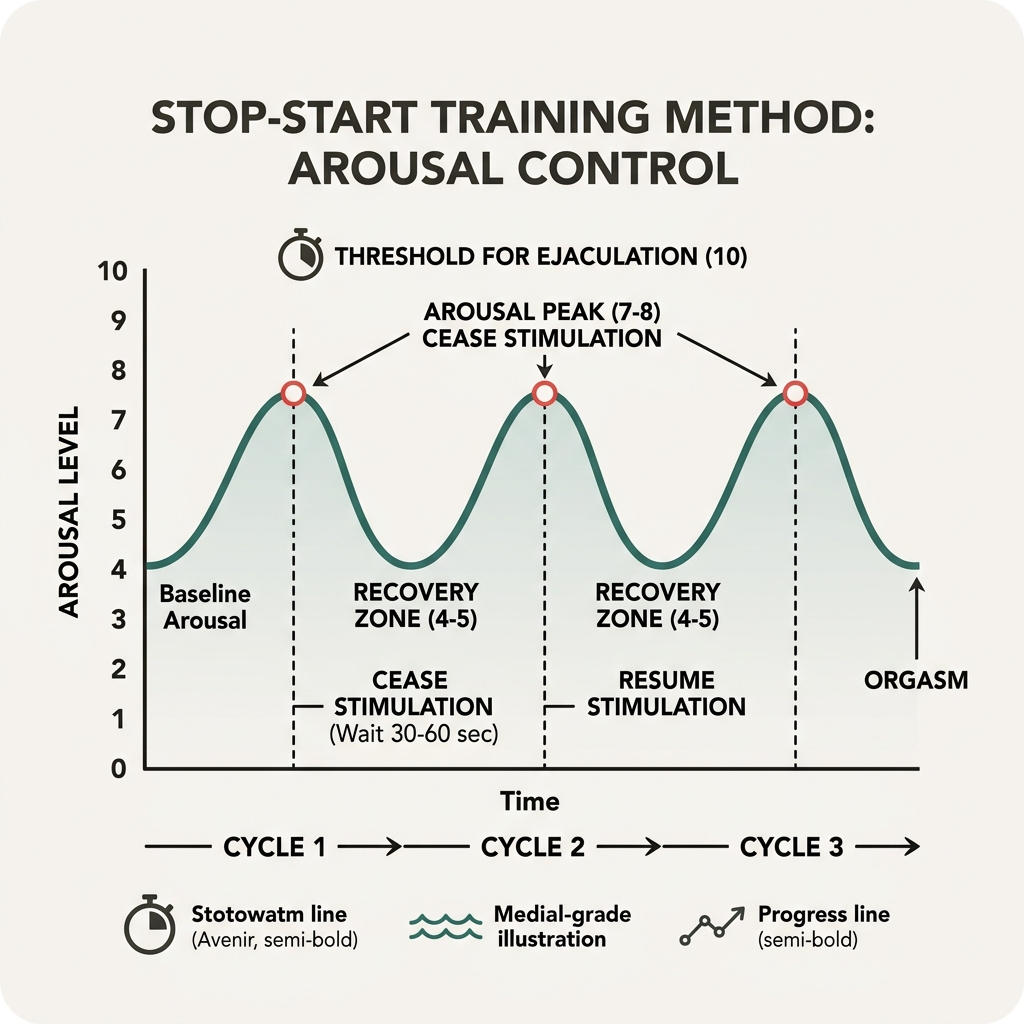
The concept is simple: you stimulate yourself until you approach the Point of No Return (PONR), then stop. You wait for arousal to decrease, then start again. By repeating this cycle over multiple sessions, your nervous system gradually learns to maintain control at higher arousal levels.
Think of it like weight training for your nervous system. Just as lifting progressively heavier weights builds muscle strength, the Stop-Start method progressively trains your ejaculatory reflex to activate at higher thresholds.
The Science Behind It
The Stop-Start method works on the principle of habituation — repeated exposure to high arousal levels without ejaculation retrains the neural pathways that control the ejaculatory reflex.
Key physiological mechanisms at play:
- Arousal Awareness — You learn to accurately identify where you are on the arousal spectrum (1-10), catching rising arousal before the PONR.
- Neuroplasticity — Repeated stop-start cycles create new neural pathways that allow for voluntary control of the ejaculatory reflex.
- Parasympathetic Activation — The "rest and digest" nervous system is strengthened during the pause phases, counteracting the sympathetic response that triggers ejaculation.
Step-by-Step Instructions
Here's exactly how to practice the Stop-Start method during a solo training session:
Set Up Your Environment
Choose a private, comfortable space where you won't be interrupted. Set a timer for your target session length. Start with 3-5 minutes in Week 1.
Begin Stimulation and Rate Your Arousal
Start self-stimulation at a moderate pace. Mentally rate your arousal on a 1-10 scale. 1 = no arousal, 10 = ejaculation. Your target zone is 7-8.
Stop at 7-8
The moment you feel yourself reaching 7-8, stop all stimulation. Remove your hand completely. This is the critical moment — stopping too late means you've passed the PONR.
Breathe and Reset
Take 3-5 slow, deep breaths (inhale 4 sec, exhale 4 sec). Wait until arousal drops to about 4-5. This typically takes 15-60 seconds. Don't rush this phase.
Resume and Repeat
Start again. Aim for 3-5 complete stop-start cycles per session. Each cycle builds the neural pathways for control.
Track Your Results
Note your total session duration, number of cycles completed, and any observations. Tracking reveals patterns and proves progress — which fuels motivation.
4-Week Training Plan
Here's a progressive training plan that mirrors clinical protocols:
Week 1: Awareness (3-5 min sessions)
Focus purely on recognizing your PONR. Don't worry about lasting long — just practice stopping before you reach the point of no return. Aim for 2-3 cycles per session.
Week 2: Breathing Integration (6-8 min sessions)
Add box breathing during the pause phases. You should start noticing that pauses become shorter — your arousal drops faster because your parasympathetic system is getting trained.
Week 3: Intensity Variation (9-12 min sessions)
Vary your stimulation speed and intensity. Practice stopping from different arousal levels (not always at 7-8, but sometimes at 6 or 9). This builds flexibility and a wider "control zone."
Week 4: Mastery (13-20 min sessions)
By now, your PONR should have shifted significantly. Practice maintaining arousal at 7-8 for longer periods (edging). Your goal is to feel in control rather than racing against a clock.
Common Mistakes to Avoid
- Stopping too late — The most common mistake. If you're at 9, it may already be too late. Practice stopping at 7, even if it feels "too early."
- Rushing the rest phase — Don't resume until you've genuinely dropped to 4-5. Impatience during rest undermines the training effect.
- Inconsistency — Sporadic practice doesn't build neural pathways. Daily sessions, even if only 5 minutes, are far more effective than occasional 20-minute sessions.
- Expecting instant results — This is training, not a magic trick. Give yourself at least 2 weeks before evaluating progress.
- Ignoring breathing — Breathing control is not optional. It's the mechanism that activates your parasympathetic nervous system during pauses.
Advanced Variations
Once you've mastered the basic Stop-Start method (typically after 2-3 weeks), you can progress to:
- Edging — Instead of stopping completely, reduce stimulation intensity to hover at 7-8 without going over. See our Edging Techniques guide.
- Variable Tempo — Alternate between slow and fast stimulation within each cycle, building tolerance to intensity changes.
- Partner Practice — Once confident solo, integrate the technique with a partner. Communication is key — tell them when you need to pause.
Practice with a Structured Program
TimingCoach automates the entire 4-week training plan with guided sessions, real-time timers, haptic feedback for stop cues, and progress tracking. It's like having a personal coach — completely private, on your device.


Frequently Asked Questions
What is the Stop-and-Start method?
The Stop-and-Start method (Semans technique) is a behavioral therapy approach where you repeatedly bring yourself close to ejaculation and then stop, training your nervous system to tolerate higher arousal levels without climaxing.
How effective is the Stop-Start technique?
Clinical research (PMC10414676) shows an 82.5% effectiveness rate when practiced consistently over 6 sessions. Most men see noticeable improvement within 1-2 weeks of daily practice.
How is Stop-Start different from the Squeeze technique?
Both involve pausing near the Point of No Return. The Squeeze technique adds physical pressure to the glans to reduce arousal, while Stop-Start relies on cessation and breathing alone. Stop-Start is simpler, easier to practice solo, and doesn't require a specific grip technique.
Can I practice Stop-Start with a partner?
Yes, once you've built confidence with solo practice (typically after 2-3 weeks). Communication with your partner is essential — let them know when you need to pause. Many couples find this deepens intimacy and mutual understanding.