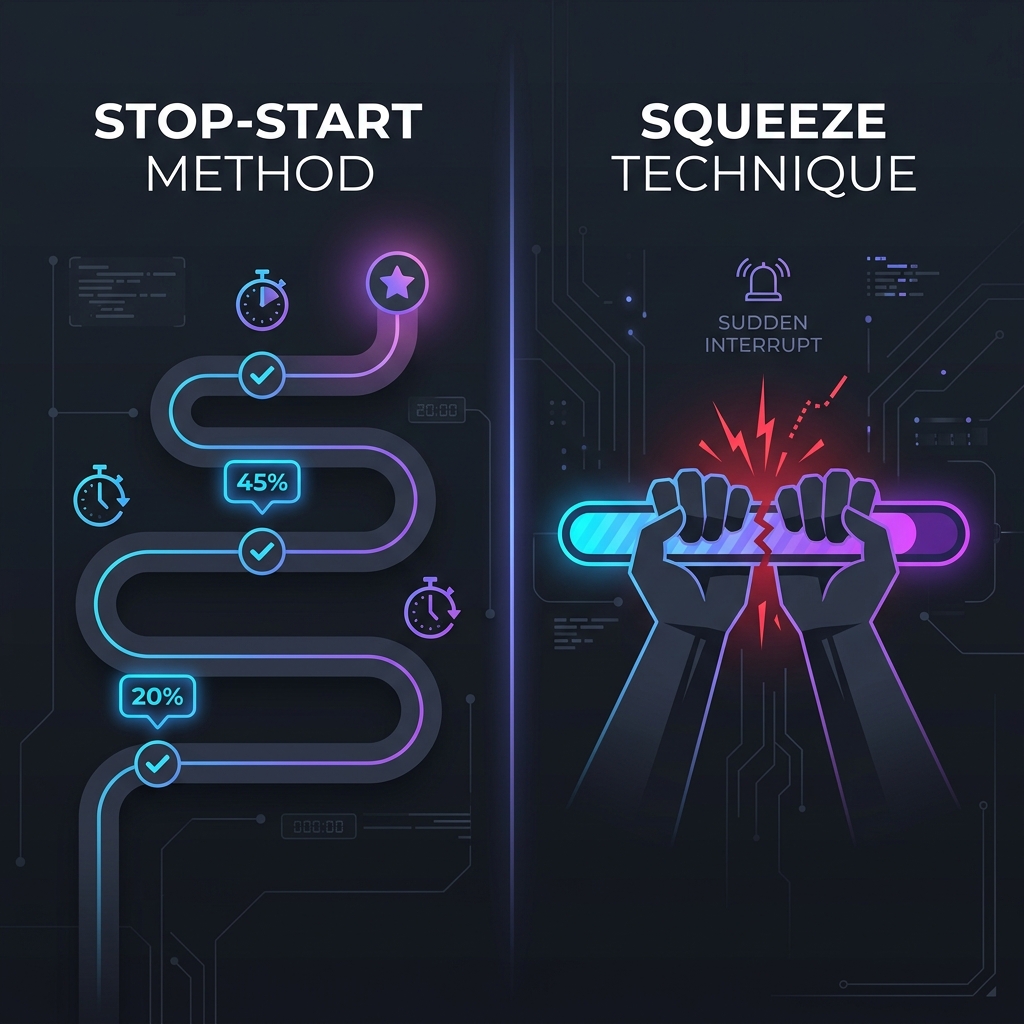
Both the Squeeze Technique and the Stop-Start method are validated behavioral exercises to delay climax, but they differ significantly in execution. While the Squeeze technique requires squeezing the tip of the penis to physically arrest ejaculation, the Stop-Start method focuses on nervous system regulation and sensory pacing. This makes Stop-Start easier to practice solo and much less disruptive to intimacy.
What is the Squeeze Technique?
Developed by renowned sex therapists William Masters and Virginia Johnson in the 1960s, the **Squeeze Technique** is a physical intervention designed to halt the ejaculation process once it has begun.
During intimacy, when a man reaches a high level of arousal (just before the Point of No Return), he or his partner stops stimulation and applies firm pressure (a squeeze) with the thumb and two fingers at the coronal ridge (where the head meets the shaft of the penis). This compression is held for 15-20 seconds. The squeeze physically reduces the erection slightly and overrides the neurological urge to climax.
What is the Stop-Start Method?
The **Stop-Start Method** (also known as the Semans technique) was developed in 1956 by Dr. James Semans. It focuses on pacing rather than physical compression.
Instead of pinching the penis when arousal peaks, you simply stop or slow down all movement. You focus on deep diaphragmatic breathing and pelvic relaxation (Reverse Kegels) to calm the nervous system. Once your excitement level drops from a 7-8 back down to a 3-4, you resume. By repeating this process, your body naturally adapts to high stimulation without triggering the ejaculatory reflex.
Key Differences: Disruption vs. Habituation
While both methods train the brain to recognize the ejaculatory threshold, their practical application differs greatly:
| Feature | Squeeze Technique | Stop-Start Method |
|---|---|---|
| Execution | Pinching the coronal ridge | Pausing and breathing |
| Solo Friendly | Poor (awkward to squeeze yourself) | Excellent (highly effective solo) |
| Intimacy Impact | High disruption (requires pausing and squeezing) | Low disruption (can blend into natural pacing) |
| Physical Comfort | Can cause discomfort or lose erection | 100% comfortable, maintains erection |
| Focus | Physical reflex interruption | Nervous system self-regulation |
Clinical Research and Long-Term Success Rates
Historically, Masters and Johnson reported very high success rates for the squeeze technique. However, modern clinical reviews show that the **Stop-Start method is preferred by patients** due to its ease of execution and superior long-term adherence.
Many couples discontinue the squeeze technique because applying a physical pinch during sex feels clinical and interrupts the mood. The Stop-Start method has a higher long-term adherence rate because it teaches pacing, which becomes an organic part of intercourse.
Which Technique is Best for You?
If you are practicing solo, or if you want a method that can be smoothly integrated into intercourse without clinical distractions, **the Stop-Start method is the clear winner**.
With an app like TimingCoach, you can practice the Stop-Start technique privately. The app provides structured timers and real-time haptic feedback, prompting you exactly when to stop and start, and includes breathing guides to help lower arousal during pauses.
Master Arousal Pacing with TimingCoach
Implement the clinical Stop-Start method with a structured 4-week program. No accounts, no servers, and 100% on-device. Let real-time haptics and guided breathing take the guesswork out of pacing.


Frequently Asked Questions
Can you combine the Squeeze and Stop-Start methods?
Yes. Some men use the Stop-Start method as their primary pacing tool, and apply the squeeze technique only if they misjudge their arousal and need an emergency stop to avoid climaxing.
How many stops should I perform in a single training session?
In a typical 10-15 minute training session, it is recommended to perform 3 to 4 stops, maintaining a high level of arousal (7-8 out of 10) during active phases and letting it drop to a 3-4 during pauses.